Behind every international visitor walking through your doors is a genuine desire to connect, learn, and immerse themselves in the stories you tell. But too often, a silent barrier stands in the way: language.
When cultural institutions plan an audio guide, the language strategy is rarely debated. The default feels obvious: provide an English track for international travelers, the local language for domestic guests, and call it a day. It is practical, familiar, and cost-effective. On paper, it seems to cover all bases.
Yet transactional fluency is fundamentally different from cultural immersion. Deciphering a flight itinerary or transit sign in a second language is routine; absorbing nuanced oral histories, ceremonial practices, and philosophical context is mentally exhausting. When confronted with that cognitive load, many guests quietly disengage, skimming placards or skipping the guide entirely.
Their hesitation isn't a lack of curiosity, it is a lack of access.
What the data showed at SAKA Museum (Jan-Sep 2026)
In January 2026, SAKA Museum launched an audio guide across six languages. Nine months of visitor data challenged the traditional playbook: the moment you remove linguistic friction and speak to visitors in their mother tongue, engagement transforms from passive viewing into eager participation.
The moment you remove the language barrier, participation surges.
Visitors desire to learn, but language barriers quietly keep them at arm's length
When guests visit a cultural museum, they arrive with genuine curiosity. However, navigating complex cultural symbolism, rituals, and regional history through a second language requires significant mental effort.
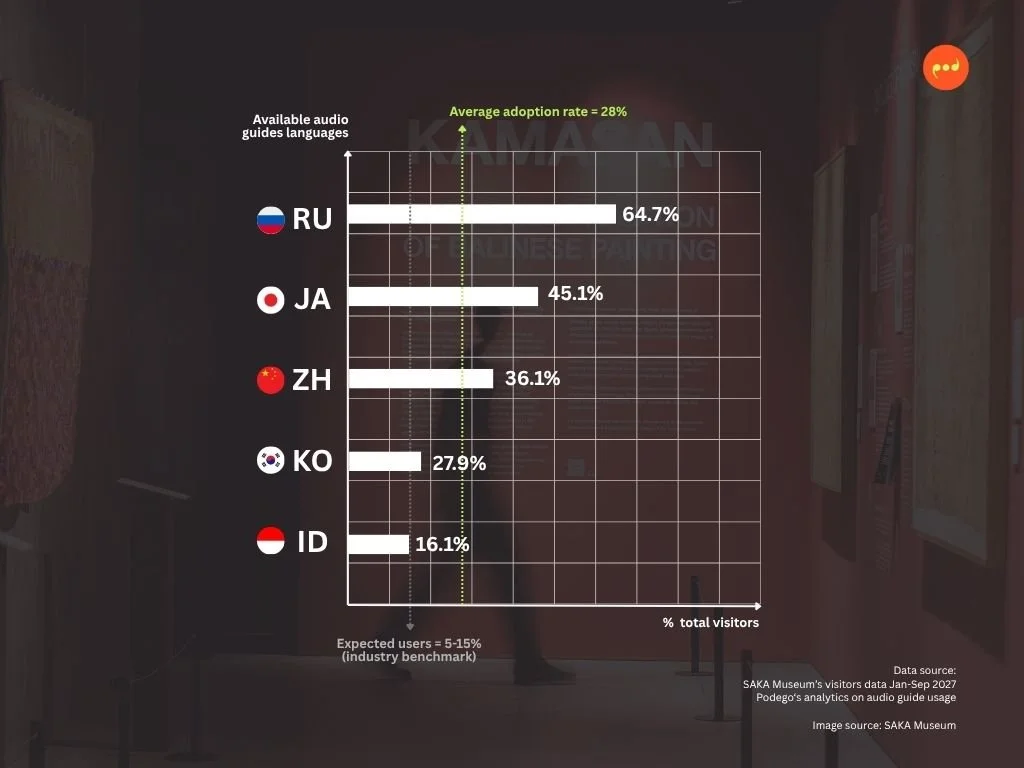
The low adoption rate among Indonesian visitors highlights this dynamic. Domestic guests used the guide least (16.1% average monthly adoption), largely because museum wall labels, panels, and room signs are already accessible to them in their primary language. They do not face an informational roadblock.
For international visitors, however, those same visual displays remain opaque. Defaulting solely to an English guide essentially forces non-anglophone travelers to translate twice, first the art, then the language. Removing that friction by offering native-language commentary bridges the gap, giving guests the confidence and comfort to engage deeply.
Visitors listen when you speak to them in their own language
Mother tongues outperformed the assumed defaults: Chinese alone recorded 1.74 times more listeners than English and Indonesian combined.
Three out of four listeners bypassed English: Chinese, Japanese, Korean, and Russian together represented almost 75% of all audio guide usage. Had we limited the launch to English and the local language, the majority of our audience would have walked through our galleries in silence.
Highest adoption belonged to non-English cohorts: Russian visitors had an adoption rate of 64.7%, followed by Japanese at 45.1% and Chinese at 36.1%, well above the museum-wide average of 28%.
Growth went where the languages were
On April 21, we expanded our offerings with Phase 2 Multitrack features. Once visitors discovered that their mother tongue was available, adoption accelerated. Comparing April to September:
Japanese audio guide monthly users surged by 607%, surpassing English by September.
Chinese audio guide monthly users by 121%
Korean audio guide monthly users increase by 91%
Usage also followed the travel calendar. February was the biggest month for Chinese, with users growth of 121% during Chinese New Year travel. Russian peaked in August at 339 users, up from 104 in July. That month a Russian visitor made a reel about our audio guide and it reached people. The timing lines up, but we can't prove the reel caused the jump, so we treat it as a promising lead and not a conclusion.
When visitors discover an institution speaks their language, word travels fast.
A fair caution
Every museum's demographic footprint is unique. SAKA Museum's figures do not mean every museum should immediately produce a Chinese or Japanese guide.
The takeaway is to stop assuming English is an acceptable substitute for genuine accessibility. Device track selections reflect active choices: when offered the choice between passive skimming and native listening, visitors overwhelmingly choose to listen.
How to choose your first audio guide languages
Start with mapping the visitors demographic. Look at ticketing data, booking sources, and visitor surveys for where your guests come from.
Measure each language separately. Track users per language each month, and let the numbers tell you where to invest next.
Plan around the travel calendar. Peaks like Easter holidays, Chinese New Year, are predictable, so your capacity and content can be too.
Signpost clearly at the entrance. Visitors who have grown accustomed to language barriers don't instinctively ask for a guide in their native tongue. Display multilingual signage to access the multilingual guide right at the desk so they instantly realize: this museum is prepared for me.
The takeaway
Visitors do not walk into museums wanting to keep their distance; they walk in wanting to understand. But when the interpretation is delivered in a second language, learning becomes a barrier.
When you provide an audio guide in a visitor's native tongue, you aren't just translating words, you are welcoming them into the conversation. Don't let habit decide who gets to understand your museum.
If your audio guide isn't multilingual, you may be missing out on international visitors. The first language on your list should come from your visitors.